Posts

Showing posts with the label Fifty Plants that Changed the Course of History

Blogging Anniversary - 10 years

Image
A while ago I checked when I did my first blog post, in order to celebrate with an anniversary post. Well, that day came and went without any reaction from me. Better late than never, so here a reminder of my very first blog post from 24 October 2012.  The book was New Finnish Grammar  by Diego Marani. Marani is an Italian novelist, translator and newspaper columnist. While working as a translator for the European Union he invented a language ‘Europanto’ which is a mixture of languages and based on the common practice of word-borrowing usage of many EU languages. It was a suitable book to start with, being a book about letters, languages and memories. With a beautiful prose, the novel went directly to my heart.  "One night at Trieste in September 1943 a seriously wounded soldier is found on the quay. The doctor, of a newly arrived German hospital ship, Pietri Friari gives the unconscious soldier medical assistance. His new patient has no documents or anything that can ide...
Fifty Plants that Changed the Course of History by Bill Laws - Bamboo

Image
Today I take a look at the bamboo, one of the most fast growing species on earth. It is used in construction as well as Asian art such as drawings and paintings made with ink.  Origin: Mostly warm, tropical regions, especially East Asia Type: Woody evergreen grass Height: Up to 30 m Edible: Yes Medical: Yes Merchandise: Yes Technical: Yes Apart from rice, no other plant has played such a big role in the history of China and the East as bamboo. You can eat the young shoots, it has been used in almost all areas of life, as well as in paintings, writing and other cultural forms. It is found in Japanese paintings and it was these paintings that inspired Claude Monet in his impressionistic art form.  There are about 1.400 species of bamboo in the world. They are used to different conditions, mountains to plains, but hardly grow on limestone soils, dry deserts or swamps. As far back as 2.000 years ago bamboo played an important role in all areas of Chinese culture. The Chinese carve...

Fifty Plants that Changed the Course of History by Bill Laws - The Onion

Image
This is a book I bought at a museum shop. I found it interesting to see which plants have made an impact on history and man. It is not a book to read from beginning to end so I take a plant at the time. I will make this a series which will be posted on Mondays. Don't worry, I will not mention all the plants, but some that are common and interesting. The first one is about the onion,  Allium copa.  Origin: Uncertain, probably Southwest Asia Type: bulbous plant Height: 30 cm or more Edible: Yes Medical: Yes Merchandise: Yes Technical: No When you cut an onion, usually the tears start coming. It is due to a sulfur-containing substance which is released. It has the same   effects as pepper spray.  Research has been done to establish whether onion tears are the same as the tears you apply to grief? Charles Darwin determined that tears of grief did not differ from those caused by onions.  However, it turned out that Darwin was wrong. The American biochemist William Fr...

Fifty Plants that Changed the Course of History

Image
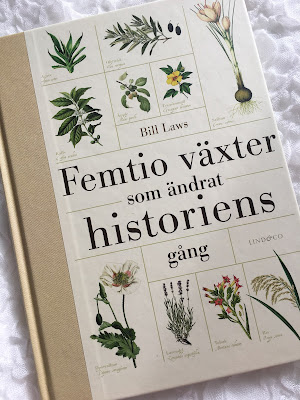
On Tuesday, I visited an old castle from the 16th century. It is called Glimmingehus and is the best-preserved Medieval building in the Nordic countries. Look out for a post about the visit on  The Content Reader Goes Outdoor   next week .  Visiting places, I enjoy looking in the museum shops. Here they had a nice mix of books and this one caught my eye and imagination.  It is about plants and their origins, their stories, and how they have played a central role for man in the development of modern society. The stories of the plants merge into economy, politics, and agriculture. Some of them are well-known, others not so much. Looking forward to seeing how these plants have shaped our society.