Posts

Blogging Anniversary - 10 years

Image
A while ago I checked when I did my first blog post, in order to celebrate with an anniversary post. Well, that day came and went without any reaction from me. Better late than never, so here a reminder of my very first blog post from 24 October 2012.  The book was New Finnish Grammar  by Diego Marani. Marani is an Italian novelist, translator and newspaper columnist. While working as a translator for the European Union he invented a language ‘Europanto’ which is a mixture of languages and based on the common practice of word-borrowing usage of many EU languages. It was a suitable book to start with, being a book about letters, languages and memories. With a beautiful prose, the novel went directly to my heart.  "One night at Trieste in September 1943 a seriously wounded soldier is found on the quay. The doctor, of a newly arrived German hospital ship, Pietri Friari gives the unconscious soldier medical assistance. His new patient has no documents or anything that can ide...

Hilary Mantel's "Wolf Hall" and "Bring Up the Bodies" adapted for television

Image
Mark Rylance as Thomas Cromwell It is with great pleasure that I have started to watch the BBC adaption of Hilary Mantel's two books, Wolf Hall and Bring Up the Bodies . The first two parts of the six part series do not disappoint. They have managed to capture the calm undertone, in spite of all the things happening, that pervades through the books. Normally, BBC does not make you disappointed when they adapt historical drama. Neither this time. The cast contains some of the finest actors in England, and it is all very professionally done. Peter Kosminsky, the director of the series, said: This is a first for me. But it is an intensely political piece. It is about the politics of despotism, and how you function around an absolute ruler. I have a sense that Hilary Mantel wanted that immediacy. ... When I saw Peter Straughan's script, only a first draft, I couldn't believe what I was reading. It was the best draft I had ever seen. He had managed to distil 1,000 pag...

New interesting books

Image
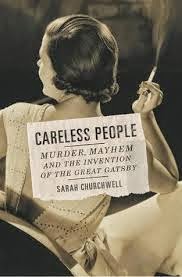
I recently found the web-site of Bookreporter  and am now subscribing to some of their newsletters. In the latest version I found two books that sound especially interesting. There are of course many more, especially a lot of thrillers/mystery books that are interesting, but these two stuck out for me. CARELESS PEOPLE: Murder, Mayhem, and the Invention of  The Great Gatsby  by Sarah Churchwell  (Literary History) CARELESS PEOPLE is a unique literary investigation: a gripping double narrative that combines a forensic search for clues to an unsolved crime and a quest for the roots of one of America’s best-loved novels. Acclaimed scholar of American literature Sarah Churchwell reconstructs the events of that pivotal autumn in 1922, revealing in the process new ways of thinking about F. Scott Fitzgerald’s masterpiece. Penguin Books * 9780143126256

Series vs Single Book

Image
It seems that the new trend in book writing is to write a series rather than a single book. There are different kind of series; those where the story continues over a number of books, or, those where the story is finished in each book, but the main character reappears in several books. The last option has been a trend for a long time, especially within the detective story genre. Some of the most famous sleuths belong to this category; Sherlock Holmes, Hercule Poirot, Miss Marple, Sam Spade and others. I think this is a favoured category among readers.

The Girl in the Photograph by Kate Riordan

Image
Author: Kate Riordan Penguin Format: Paperback Published: 15 Jan 2015 Two generations, two women, two mansions and a hidden secret going down through history. This is my kind of book indeed. Kate Riordan's first book does not disappoint you. The story is told with two voices; Alice’s and Elisabeth’s. Elizabeth is the unhappy woman, in the 1890s, who once inhabited Stanton house. Alice is the young girl, finding herself unmarried and pregnant in 1933s London. Her shameful mother makes up a story that she is a widow and sends her to a childhood friend in the country to await the birth. Alice is unhappy about the whole situation when she arrives at Fiercombe Manor.  The house is an old and lovely Tudor house, but she can feel a non-visible presence. Someone is watching her. Old houses like this always have their own ghosts, but Alice feels that there is something more. Little does she know how Elizabeth's life will be intertwined with her own and how her own life will cha...

Enjoying a winter week in Madonna di Campiglio, Italy

Image
For the first time in years I am enjoying a real winter. We were lucky enough that the snow came just the day before we came. We had a lovely drive from Bergamot via lake Garda to MdC. Here some photos along the way.

Jane Austen and Names by Maggie Lane

Image
After finishing Jane Austen and Food   it was time to get on with Maggie Lane’s Jane Austen and Names . Names have a special meaning to most of us, and mostly names mean more than just the name itself. In this study, Maggie Lane has looked at an area which has not been given much attention. She looks at the history of English names up to Jane Austen’s time and the pattern of giving names in society, and the way Jane Austen uses names that fits the personality of her characters, as well as their place in society. Unlike most novelists of her period, Jane Austen used names found in everyday life. Sometimes she uses a name to explain the characteristics; “Her Charlottes are usually clear-eyed pragmatists and her Henrys are rarely without charm. More often, characters given the same name have nothing in common at all. In one novel Fanny might be a despicable, mercenary snob, and in another the timid, tender-hearted heroine. George Wickham and George Knightley are morally worlds ap...

Jane Austen and Food by Maggie Lane

Image
Jane Austen never gave much detail to food and eating in her novels. Still, food is a very important part of her writing, since all references to food and eating, although indirect, suggests something about the character who refers to it. Maggie Lane, an English author of several books about Jane Austen and her time, has examined the books to find out Jane Austen’s attitude to food and how it affects the social sphere and customs of her characters. Maggie Lane starts: “One of the characteristics of Jane Austen’s style is how sparing it is of physical detail. She never pauses in her narrative to give a lengthy description, whether of faces, clothes, rooms, meals or any other facet of material life. … Jane Austen pays us the compliment of letting us imagine for ourselves. …” Jane Austen grew up in the countryside as one of eight children. Her father was a reverend, but also a gentleman farmer, so the household was more or less self sufficient during her early life. Her mother catered...